The compliance changes you can't afford to ignore
Why waiting could cost your business more than you think
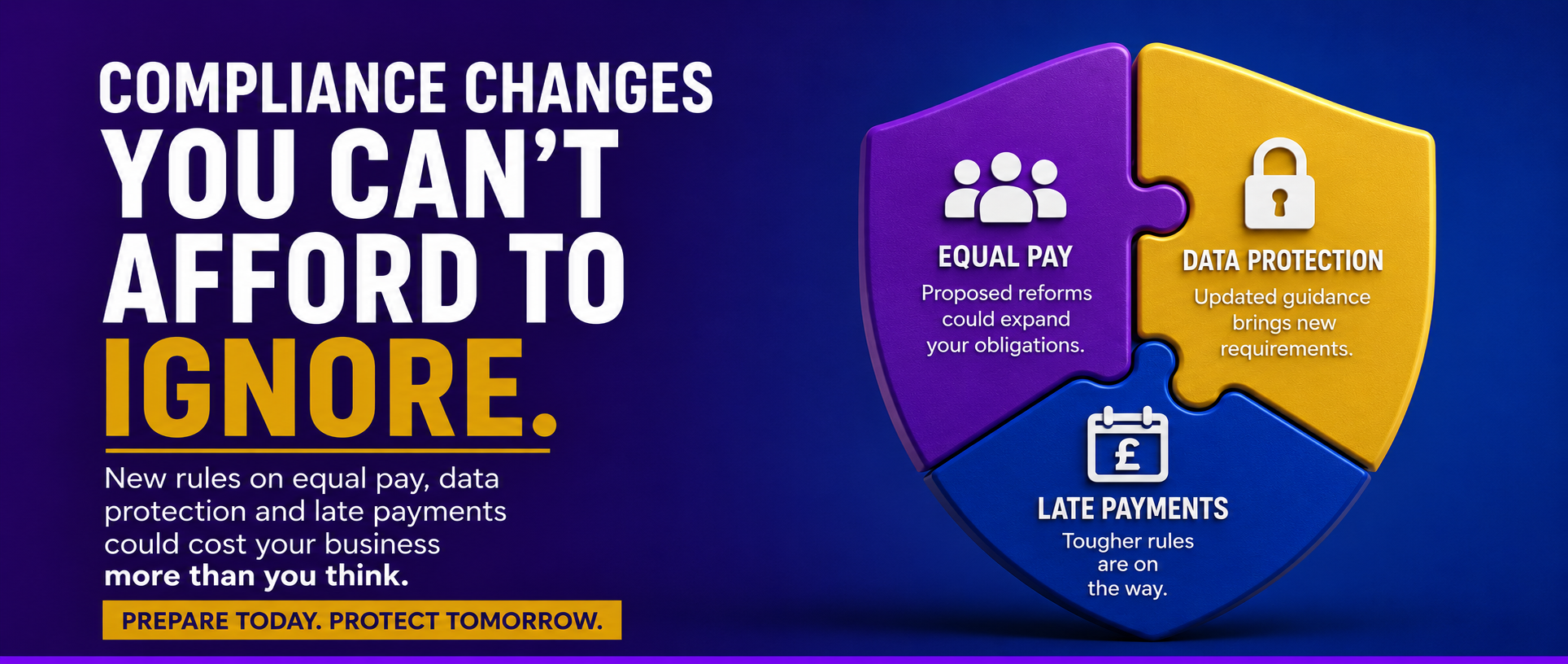
Three UK changes are moving at the same time: equal pay reform, updated ICO guidance and tougher late payment rules. Not all of it is law yet, but regulators now expect you to prove your systems work, not just show them a policy. The businesses that get caught out are rarely the ones breaking rules deliberately.
Key takeaways
- The equal pay consultation closes on 27 October 2026, and it could extend responsibility into your outsourced and subcontracted work.
- Since 19 June 2026 you have been expected to acknowledge a data protection complaint within 30 days, investigate it and tell the person the outcome.
- Late payment proposals include a 60-day maximum term and mandatory statutory interest at 8% above base rate.
- Poor record keeping does not usually cause the problem. It makes the problem far more expensive to defend.
- Every one of these can be prepared for now, before the legislation lands.
Most business owners do not wake up thinking about legislation.
They think about customers, cash flow and getting through another busy day.
Regulators take a very different view.
Whether a legal change is already in force or still working its way through Parliament, failing to prepare can leave a business exposed to fines, complaints, damaged reputations and unnecessary cost.
This article looks at three UK developments that every small service business should know about: proposed equal pay reforms, changes to data protection guidance, and the Government's plans to tackle late payment.
Not every proposal is law yet. The direction of travel is clear. Businesses are expected to have better systems, clearer records and stronger governance.
1. Proposed equal pay reforms
Consultation published 14 July 2026
On 14 July 2026 the Government launched a 15-week consultation on expanding equal pay protections.
Proposals include wider pay transparency, stronger enforcement, greater protection relating to race and disability pay discrimination, and responsibilities that could extend into outsourced and subcontracted work.
The consultation closes on 27 October 2026.
These measures are not yet law. That is not a reason to wait.
Start reviewing job descriptions, pay decisions, contractor arrangements and the evidence behind any differences in remuneration.
Poor record keeping could make a future claim much harder to defend.
Equal pay claims already result in legal costs, compensation, back pay and reputational damage.
2. ICO privacy notice and right to object updates
July 2026
The Information Commissioner's Office updated its privacy notice generator on 7 and 10 July 2026 to reflect the Data (Use and Access) Act 2025.
On 23 July 2026 it also updated its guidance covering the right to object and recognised legitimate interests.
Check that your privacy notices, complaint procedures, lawful basis assessments and marketing processes are current.
Since 19 June 2026, organisations are expected to provide a clear route for data protection complaints, acknowledge them within 30 days, investigate them and communicate the outcome.
Failure to comply with UK data protection law can result in enforcement action by the ICO, substantial financial penalties in serious cases, complaints from individuals and reputational harm.
Even where no fine is imposed, poor documentation quietly increases the time and the cost of responding to a complaint.
3. Tougher late payment rules announced
24 July 2026
On 24 July 2026 the Government confirmed plans to introduce stronger protections against late payment.
Proposals include a maximum 60-day payment term, mandatory statutory interest of 8% above the Bank of England base rate, stronger powers for the Small Business Commissioner and tighter reporting requirements.
Legislation is still required.
In the meantime, review your customer contracts, invoice approval process, dispute procedure and credit control.
Businesses relying on informal payment practices are the ones most likely to be disrupted when the rules arrive.
The bigger message
These updates have one thing in common.
Compliance is no longer about having a policy in a folder.
Regulators increasingly expect a business to demonstrate that its systems actually work.
Good documentation, defined responsibilities, consistent processes and accurate records reduce risk. They also improve efficiency and profitability.
If a business is continually firefighting, compliance tasks are the first things to slip.
They are also the issues that become most expensive when something goes wrong.
What you can do today
- Review your privacy notices and complaint procedures.
- Document how pay decisions are made.
- Review outsourced supplier and contractor agreements.
- Check your invoice, dispute and debt recovery processes.
- Make sure responsibility for compliance is clearly allocated to a named person.
- Keep evidence that your procedures are actually followed in practice.
Final thoughts
Every year brings new legal requirements, consultations and regulator guidance.
Businesses with solid operational systems adapt quickly and confidently.
Those relying on memory, inboxes and good intentions usually spend far more fixing problems than they would have spent preventing them.
Frequently asked questions
About the Author

Julie-Ann Adams
Founder, The Efficiency Method
Julie-Ann has spent thirty years running operations, including building a waste and recycling business to £8 million, and is the first certified lead auditor in the world for EN 50625 and EN 50614. She now works with owner-managed businesses across the UK, finding where money, time and control are being lost, and fixing the cause rather than the symptom.
Share this Article
Ready to strengthen your business?
I help owner-managed businesses create practical systems that reduce costs, improve productivity and support compliance without unnecessary complexity.