

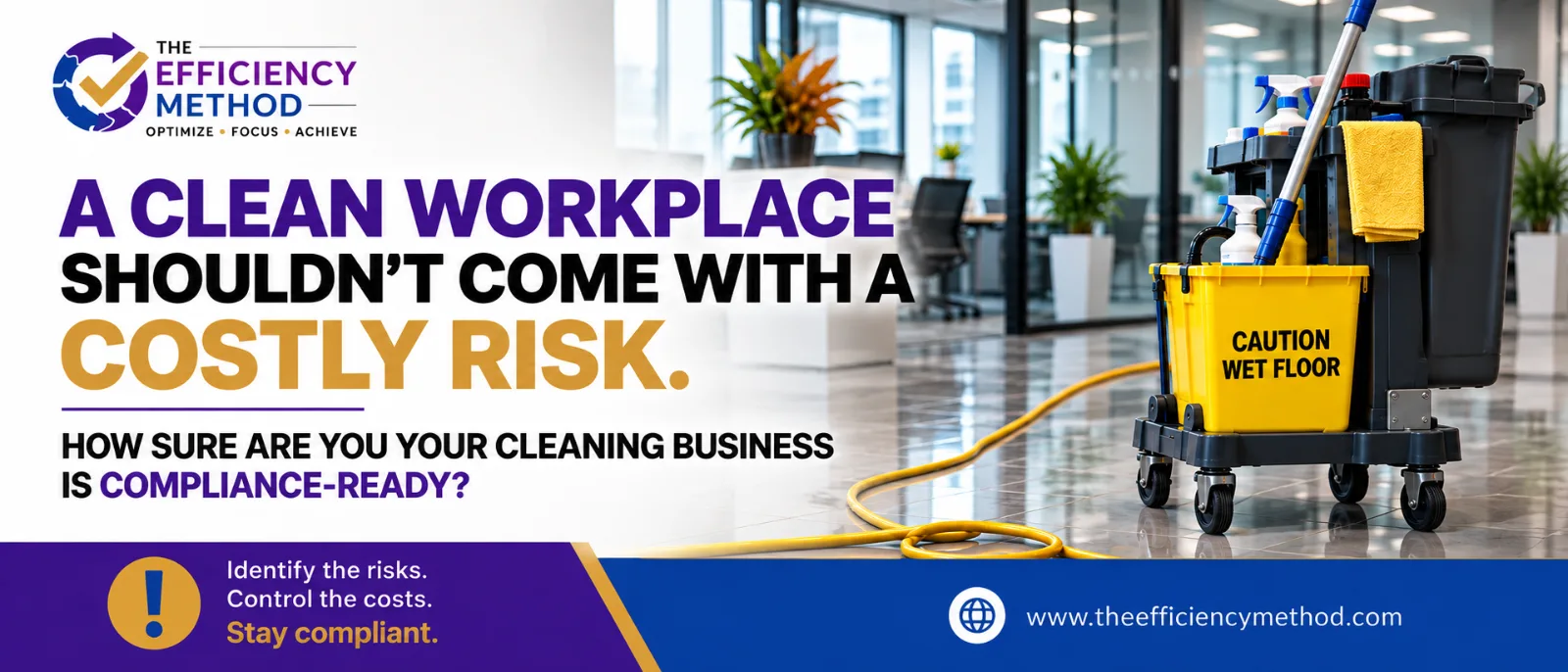
Can Your Cleaning Business Prove Compliance?
The hidden cost of compliance often lives in folders, inboxes and people’s heads.
Having compliance documents somewhere in the business is not the same as having a controlled compliance system. For commercial cleaning companies, missing, outdated or inaccessible evidence can create significant financial, operational and contractual risk.
Key takeaways
- Compliance evidence needs to be current, controlled and easy to produce.
- Weak COSHH, workforce and site records can expose cleaning businesses to significant financial risk.
- A simple compliance system can reduce chasing, strengthen control and improve client confidence.
A client asks for your COSHH assessments, training records, Right to Work evidence, insurance certificate and the risk assessment for tonight’s clean.
You know you have them.
The question is: where?
One is in SharePoint. One is attached to an old email. The supervisor has the latest chemical sheet on their phone. The insurance certificate was renewed last month, but the tender folder still contains the old one. Nobody is quite sure whether the new starter’s training record was signed.
That is not a paperwork problem. It is an operational control problem, and in commercial cleaning it can become an expensive one very quickly.
THE HIDDEN QUESTION: DO YOU HAVE COMPLIANCE OR JUST DOCUMENTS?
The original version of this blog made an important point: having insurance certificates, qualifications, risk assessments, policies and training records somewhere in the business is not the same as having a compliance system.
For a commercial cleaning company, that distinction matters even more. Your people often work unsupervised, out of hours and on somebody else’s premises. They use chemicals, machinery and access equipment. They may work around moving vehicles, members of the public, confidential material or client-specific hazards.
So the real test is not whether a document exists. It is whether the business can answer five questions immediately:
- What evidence do we need?
- Where is the current version?
- Who owns it?
- When does it expire or need reviewing?
- Can we prove the right person has seen, understood or completed it?
If any answer depends on “ask Sarah”, “check the office”, “I think it’s in the folder” or “we’ll find it if the client asks”, you have hidden compliance risk.
HIDDEN COST #1: ONE INCIDENT CAN COST FAR MORE THAN THE CLEANING CONTRACT
Health and safety is not theoretical. HSE’s latest figures estimate that workplace injury and new cases of work-related ill health cost Great Britain £22.9 billion in 2023/24. HSE estimates an average cost of around £10,000 per workplace injury case and £24,200 per new case of work-related ill health.
Employers collectively carried £4.3 billion of the overall cost.
Cleaning has its own obvious exposures. HSE identifies slips and trips, COSHH, dermatitis, musculoskeletal disorders and work at height among the common risks in cleaning. It also warns that some cleaning products can cause skin allergies, asthma, burns and eye damage.
A cleaning company therefore needs more than a generic risk assessment written three years ago. The controls need to match the actual site, task, chemical, equipment and worker.
A stark example came in Northern Ireland in 2025. Specialist cleaning company NII Clean Limited was fined £4,000 after an employee fell around three metres while preparing for roof-cleaning work.
The investigation found that the company had failed to complete a suitable and sufficient risk assessment for the work. The fine was only one part of the real cost: an injured employee, investigation time, management disruption and reputational exposure all sit around it.
And where cleaning takes place inside another operation, responsibility does not simply disappear. In a separate HSE prosecution, a commercial cleaner was killed after being struck by a reversing bus at a depot. HSE found failures in the system of work and in controlling pedestrian and vehicle risks.
The hidden question is simple: if one of your cleaners is injured tonight, can you show tomorrow morning exactly what was assessed, what they were trained to do and what controls were in place?
HIDDEN COST #2: CHEMICAL COMPLIANCE THAT STOPS AT THE SAFETY DATA SHEET
A folder full of Safety Data Sheets is not a COSHH system.
HSE says employers using hazardous substances must assess the risks, prevent or adequately control exposure, and provide staff with information, instruction and training. For cleaners, frequent wet work and contact with products can contribute to dermatitis, while ingredients in some products can cause allergies and asthma.
The operational gap often appears after the assessment is written:
- A product is substituted at short notice.
- A new concentrate is introduced but the site file is not updated.
- Gloves are provided, but nobody checks whether they are suitable for the chemical.
- A cleaner is shown the cupboard but not trained on dilution, spills or first aid.
- The client changes the task, but the COSHH assessment remains unchanged.
That is where a compliance document becomes false reassurance.
Your system should connect the product, current SDS, COSHH assessment, approved method, PPE, training and review date. If one changes, the system should trigger the others.
HIDDEN COST #3: PAYROLL AND WORKFORCE RECORDS CAN BECOME A £45,000 TO £60,000 PROBLEM
Commercial cleaning is labour-intensive. Small errors repeated across a workforce can become large liabilities.
National Minimum Wage compliance is not simply checking the hourly rate on the payroll report.
GOV.UK confirms that certain work-related costs paid by a worker, including items such as uniform or safety equipment where applicable, can affect minimum wage calculations. Working time, deductions and unpaid time around shifts can therefore matter.
Right to Work evidence is another area where “we checked their ID” is not enough. Employers can face civil penalties of up to £60,000 for each illegal worker where the correct checks have not been carried out. The current civil penalty code uses a starting point of £45,000 for a first breach and £60,000 for a repeat breach, before applicable reductions.
For a cleaning company recruiting frequently, using multiple sites and relying on supervisors to onboard staff, that creates a dangerous hidden question: who actually checks, records and retains the evidence, and how do you know the process happened every time?
Five workers without a defensible Right to Work process is not five small admin mistakes. At the maximum repeat-breach level, the exposure could reach £300,000.
HIDDEN COST #4: THE CONTRACT YOU LOSE BEFORE ANYONE FINES YOU
This is the cost many owners underestimate.
Your client may never see an HSE inspector. You may never receive a penalty. But your compliance system can still cost you a contract.
Commercial clients increasingly expect suppliers to evidence insurance, risk assessments, COSHH, training, accident reporting, workforce checks and other controls. The problem is often exposed at renewal, audit, mobilisation or tender stage.
Imagine a £6,000-a-month cleaning contract worth £72,000 a year. The service is good. The client is happy. Then procurement asks for updated evidence and you cannot produce it cleanly. The certificate is expired, training records are incomplete and three versions of the same policy exist.
Even if the client gives you time to fix it, what have you just demonstrated? Not control. Not confidence. Not a business that makes their supplier management easy.
The £72,000 contract may be the visible risk. The hidden cost is the management time spent rebuilding records under pressure, the margin lost while senior people chase paperwork and the reduced confidence when the next tender lands.
THE SOLUTION: BUILD A COMPLIANCE SYSTEM, NOT A BIGGER FOLDER
A useful compliance system does not need to be complicated. It needs to be controlled.
For a commercial cleaning company, I would expect it to give management one clear view of the obligations that matter across the business and each client site.
At minimum, it should show:
- Requirement: what evidence, check, assessment or action is required.
- Owner: one named person accountable for keeping it current.
- Location: one controlled place for the current record.
- Review/expiry date: with reminders before the deadline.
- Status: current, due, missing or action required.
- Evidence: proof that training, checks, inspections or acknowledgements happened.
- Site/client link: where requirements vary by contract or location.
Then add a regular review. Not an annual panic. A short, scheduled management check that asks what has changed: new staff, new sites, new chemicals, new equipment, new client requirements, incidents, near misses, insurance renewals or legislative changes.
That is how compliance moves from background administration to active operational control.
THE RESULT: LESS CHASING. MORE CONTROL. STRONGER CLIENT CONFIDENCE.
The purpose is not to create more paperwork.
It is to stop the expensive scramble.
A controlled compliance system means a supervisor knows what is required before a cleaner starts. A manager can see what is due without searching six folders. A client request can be answered quickly. An expired document does not sit unnoticed for four months. A new chemical does not arrive on site without the controls changing with it.
Most importantly, the business can demonstrate that it is being actively managed.
That matters when you are protecting employees. It matters when an insurer asks questions. It matters when a client audits you. And it matters when you are competing against another cleaning company for a contract.
SO, WHAT WOULD HAPPEN IF A CLIENT ASKED TODAY?
Could you produce the current risk assessments, COSHH records, insurance, training evidence, workforce checks and site-specific requirements quickly, without ringing three people and searching old emails?
If the answer is anything other than an immediate yes, the hidden cost is already sitting inside the business. You just have not received the invoice yet.
Need help?
If you run a commercial cleaning company and want a quick chat to understand your business risk, get in touch. I have spent more than 30 years in leadership and completed more than 800 business reviews and audits. I look beyond whether a document exists and test whether the process around it works. I will look at where money, time and control are leaking from the operation, including the systems that should be protecting your compliance and your client contracts.
hello@tem101.com
www.theefficiencymethod.com
Sources
Health and Safety Executive (HSE), Health and safety at work: Summary statistics for Great Britain 2025; Costs to Britain 2023/24.
HSE, Common risks in cleaning; COSHH and cleaners; Control of substances hazardous to health (COSHH); Work-related contact dermatitis.
Health and Safety Executive for Northern Ireland, NII Clean Limited prosecution, 25 June 2025.
HSE Media Centre, Arriva and cleaning firm fined after worker killed at bus depot, 8 January 2024.
GOV.UK, National Minimum Wage: Employers and the minimum wage.
GOV.UK / Home Office, Right to Work civil penalty guidance and Code of Practice, updated 2026.
Frequently asked questions
About the Author

Julie-Ann Adams
Founder, The Efficiency Method
Julie-Ann has spent thirty years running operations, including building a waste and recycling business to £8 million, and is the first certified lead auditor in the world for EN 50625 and EN 50614. She now works with owner-managed businesses across the UK, finding where money, time and control are being lost, and fixing the cause rather than the symptom.
Share this Article
Ready to strengthen your business?
I help owner-managed businesses create practical systems that reduce costs, improve productivity and support compliance without unnecessary complexity.