Contract or Agreement? What Really Matters
What UK businesses need to know before a handshake, proposal, membership or subscription becomes an expensive dispute
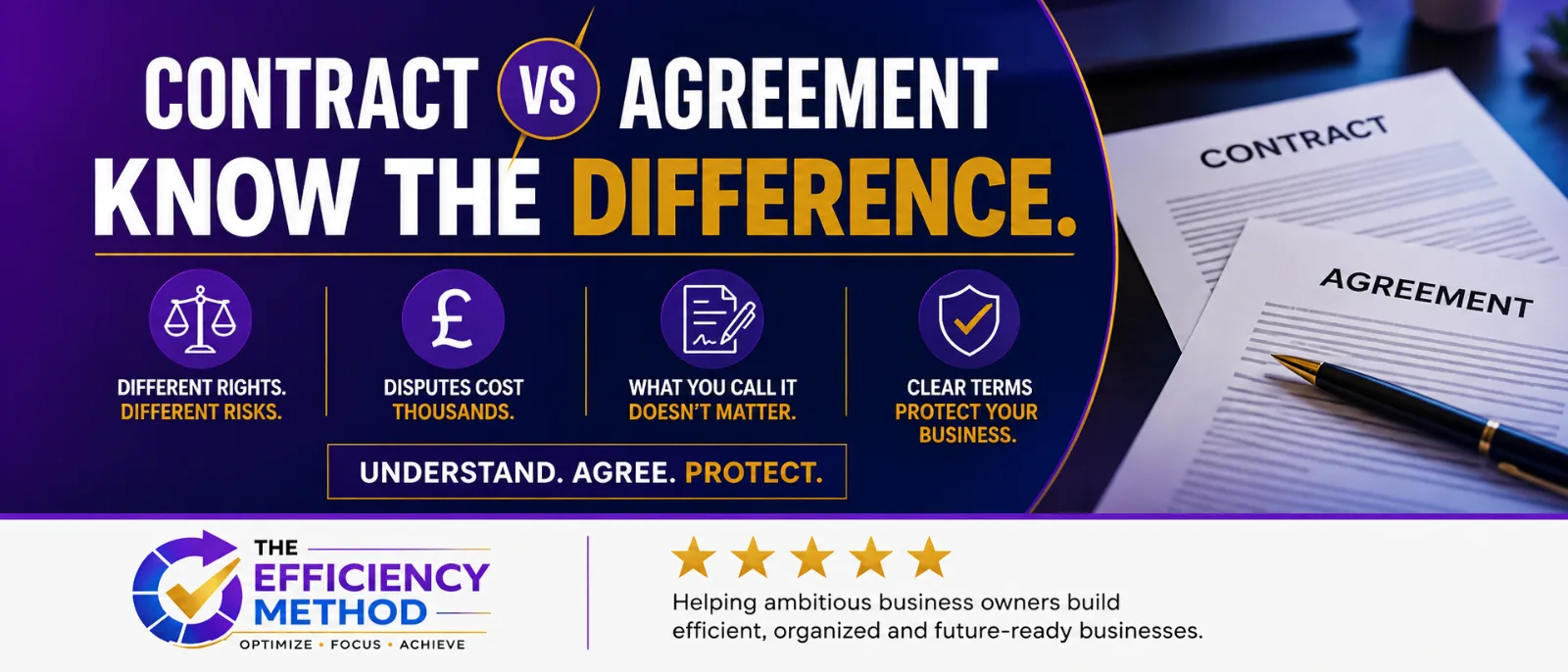
Calling a document an agreement rather than a contract does not determine whether it is legally binding. For SMEs, the real commercial risk is uncertainty about what was agreed, including scope, price, changes, renewals and exit terms.
Key takeaways
- A document called an agreement, proposal, membership, subscription or service plan can still be a legally binding contract.
- A contract does not always need a signature or formal document and may arise through emails, conversations, accepted quotations, purchase orders, online acceptance, payment or conduct.
- Strong contract protection depends on operational processes that ensure what is sold, approved, delivered, changed, billed, renewed and terminated matches the agreed terms.
You agree a price. The customer says yes. Work starts. Everyone is happy - until the invoice is challenged, the scope changes, a renewal appears, somebody wants to leave, or one side insists, “That was never what we agreed.”
At that point, calling the paperwork an “agreement” rather than a “contract” will not rescue either party.
Under the law of England and Wales, the real question is whether the arrangement has the ingredients of an enforceable contract and, crucially, what terms can actually be proved.
For an SME, that distinction is not legal trivia. It can decide whether you get paid, whether a customer can walk away, whether you can increase a price, who carries the cost of extra work and how expensive the argument becomes.
Agreement and contract: what is the difference?
In everyday business language, an agreement is simply an understanding between parties. A contract is an agreement that the law recognises as creating enforceable obligations. So every contract involves agreement, but not every agreement is necessarily a legally enforceable contract.
A binding contract will normally require a clear agreement through offer and acceptance, consideration - something of value being exchanged - an intention to create legal relations, sufficiently certain terms and parties with legal capacity. Importantly, offer and acceptance may be written, spoken or implied by conduct.
That means a document headed “Agreement”, “Proposal”, “Membership”, “Subscription” or “Service Plan” can still be a contract. Equally, a beautifully designed document headed “Contract” will not cure fundamental uncertainty about what the parties actually promised.
The dangerous SME myth: “Nothing was signed, so there is no contract”
This is where businesses get caught. A contract does not always need a wet signature or even a formal document. Depending on the circumstances, a binding arrangement can arise through emails, a telephone conversation, an accepted quotation, a purchase order, clicking an online acceptance box, paying an invoice, or simply starting to perform what was agreed.
The commercial problem is therefore often not whether a contract exists. It is proving exactly what the contract says.
Imagine a client asks for “a few additional changes” during a project. Your team completes them. The client later argues that they were included in the original price. Without a clear scope, change-control process and record of approval, the business may have delivered extra work while creating a dispute about whether it can charge for it.
Written contract versus informal agreement: the real pros and cons
The advantage of informality is obvious: it is quick, friendly and commercially easy. The disadvantage is that the “friendly” stage is exactly when nobody expects to need evidence. By the time they do, memories have changed, staff have left and the email trail may tell three different stories.
A written contract can create one place to record scope, price, responsibilities and key dates. It can define payment arrangements, variations, renewal and termination rights.
An informal agreement may feel faster and more flexible, but:
- Evidence may depend on emails, messages, recollections and conduct that conflict.
- Payment expectations may be assumed rather than agreed.
- Casual changes can create uncertainty.
- Each party may have a different view of how the arrangement ends.
- A dispute can become an argument about both the facts and the legal terms.
For businesses, the wording matters more because statutory protection is thinner
Business-to-business customers generally have substantially less statutory protection than consumers. The starting point is therefore the contract itself, alongside general contract law and legislation that may apply in particular circumstances, including the Unfair Contract Terms Act 1977 and the Misrepresentation Act 1967. For some service arrangements, the Supply of Goods and Services Act 1982 may also imply obligations where the contract does not deal with them.
This makes contract discipline particularly important for SMEs. A limited company buying a business service will not normally receive the protections of the Consumer Rights Act 2015. A sole trader can also be acting as a business customer when the purchase is mainly for their trade.
What should a business contract actually control?
A twenty-page document is not automatically better than a four-page one. The useful contract is the one that deals clearly with the points most likely to cost money or damage the relationship.
- Exactly what is being supplied - and what is not included.
- Price, VAT, deposits, expenses, payment dates and what happens if payment is late.
- Who can approve extra work, variations or additional costs.
- The customer obligations and information or access they must provide.
- Timescales, dependencies and what happens when delays are outside your control.
- Ownership and use of intellectual property, documents, data or materials where relevant.
- Liability, insurance and any lawful limitations or exclusions.
- The initial term, renewal mechanism and notice period.
- Termination rights, including serious breach and unpaid invoices.
- What happens on exit: final fees, prepaid sums, data, property and work in progress.
Price rises: can you simply put your price up?
Not safely just because costs have increased. During a fixed term, a supplier will generally need either an incorporated price-variation clause or the other party’s agreement to the change.
For a B2B contract, a properly drafted price-rise mechanism is more likely to be enforceable than a vague statement that prices “may change”. A useful clause should make clear when a review can happen, how the new price is calculated or determined, what notice is given and what rights - if any - the customer has to terminate.
At renewal, a supplier can usually offer a new price for the next period, subject to the existing terms and the required notice. The operational lesson is simple: do not leave renewal and price communication to memory. Build the dates, notices and approvals into your process.
Ending the relationship: cancellation is not the same as termination
Businesses also create confusion by using “cancel” as a catch-all word. Legally and commercially, several different events may be involved:
- Expiry - the agreed fixed term ends.
- Termination on notice - a party uses a contractual right to end the arrangement after the required notice.
- Termination for breach - a sufficiently serious breach gives a right to terminate, subject to the contract and applicable law.
- Rescission - in certain circumstances, such as actionable misrepresentation, the contract may be unwound.
- Consumer cancellation - a statutory cooling-off or other consumer right may apply.
One practical trap deserves particular attention: stopping a Direct Debit or standing order is not necessarily the same as terminating a contract. If a genuine minimum term remains in force, the payment obligation may continue even though the payment instruction has been cancelled.
The small consumer section: businesses selling to individuals have extra duties
If your customer is buying mainly for personal rather than business purposes, the position changes. Consumer law can override what your document says, so a signed term is not automatically enforceable merely because the consumer accepted it.
The Consumer Rights Act 2015 requires consumer services to be performed with reasonable care and skill and requires consumer terms to be fair and transparent. Unfair terms are not binding on the consumer. The Consumer Contracts Regulations 2013 impose information and cancellation requirements on many distance and off-premises contracts, including online and telephone sales; consumers commonly have a 14-day cancellation period for service contracts, subject to the detailed rules and exceptions.
Businesses using consumer subscriptions should also prepare for the specialist subscription-contract regime in the Digital Markets, Competition and Consumers Act 2024. The legislation provides for clearer pre-contract information, reminder notices and rights around ending subscription contracts. As at September 2026, the Government has been implementing the regime, so businesses should check commencement dates and final regulations before relying on a future start date.
Consumer-facing terms also need particular care around unilateral price rises, long notice periods, disproportionate exit charges, hidden renewals and one-sided termination rights. The Competition and Markets Authority’s guidance makes clear that consumer terms and notices must be fair and transparent.
So which is better: a contract or an agreement?
If by “agreement” you mean a clear written document intended to create legal obligations, there may be no meaningful difference at all - it may already be a contract.
If by “agreement” you mean a loose understanding, a short email, a handshake or a proposal that leaves key issues unstated, the apparent simplicity can become expensive. The risk is not the title. The risk is uncertainty.
For most SME trading relationships, the stronger approach is a proportionate written contract: clear enough to protect the business, short enough to be used, and matched by operational processes that ensure staff actually follow it.
The contract in the drawer is not enough
This is the point many businesses miss. A good contract can still fail operationally if the sales team promises something different, staff start work before approval, nobody records variations, renewal dates are missed, invoices do not match the agreed schedule or termination notices sit unread in an inbox.
The strongest businesses connect the legal document to the way work is actually sold, approved, delivered, changed, billed, renewed and closed. That is where contract protection becomes commercial control.
Five questions to ask this week
- Could you prove the exact scope, price and payment terms for every active client?
- Who in your business is allowed to agree extra work or change a customer commitment?
- Do your renewal and notice dates sit in a system, or in somebody’s memory?
- Do your invoices and operational processes match what the contract says?
- If a customer wanted to leave today, could your team explain the correct process without guessing?
Final thought
Calling something an agreement does not make it informal. Calling it a contract does not make it good.
The commercial protection comes from knowing what has been agreed, recording it clearly and running the business in a way that matches those terms.
If your contracts, memberships, subscriptions or service agreements have grown organically - or the paperwork says one thing while the business does another - that gap is worth finding before a customer, supplier or solicitor finds it for you.
The Efficiency Method reviews the operational controls around contracts - including approvals, scope changes, renewals, records, invoicing and exit processes - to identify where unclear responsibilities or weak processes could be costing you money, time or control.
This article provides general information for businesses in England and Wales and is not legal advice. Specific contracts and disputes should be reviewed by your appropriately qualified legal professional.
Sources and further reading
- HMRC, “Formation of an enforceable contract” (updated 7 April 2026)
- Office of the Small Business Commissioner, “A Guide to Creating a Contract”
- Competition and Markets Authority, “Writing a fair contract for customers” (updated 22 July 2026)
- Competition and Markets Authority, “Unfair contract terms” (updated 22 July 2026)
- Consumer Rights Act 2015
- Digital Markets, Competition and Consumers Act 2024, Part 4 Chapter 2
- Department for Business and Trade, subscription contracts regime consultation and 2026 outcome
Frequently asked questions
About the Author

Julie-Ann Adams
Founder, The Efficiency Method
Julie-Ann has spent thirty years running operations, including building a waste and recycling business to £8 million, and is the first certified lead auditor in the world for EN 50625 and EN 50614. She now works with owner-managed businesses across the UK, finding where money, time and control are being lost, and fixing the cause rather than the symptom.
Share this Article
Ready to strengthen your business?
I help owner-managed businesses create practical systems that reduce costs, improve productivity and support compliance without unnecessary complexity.