

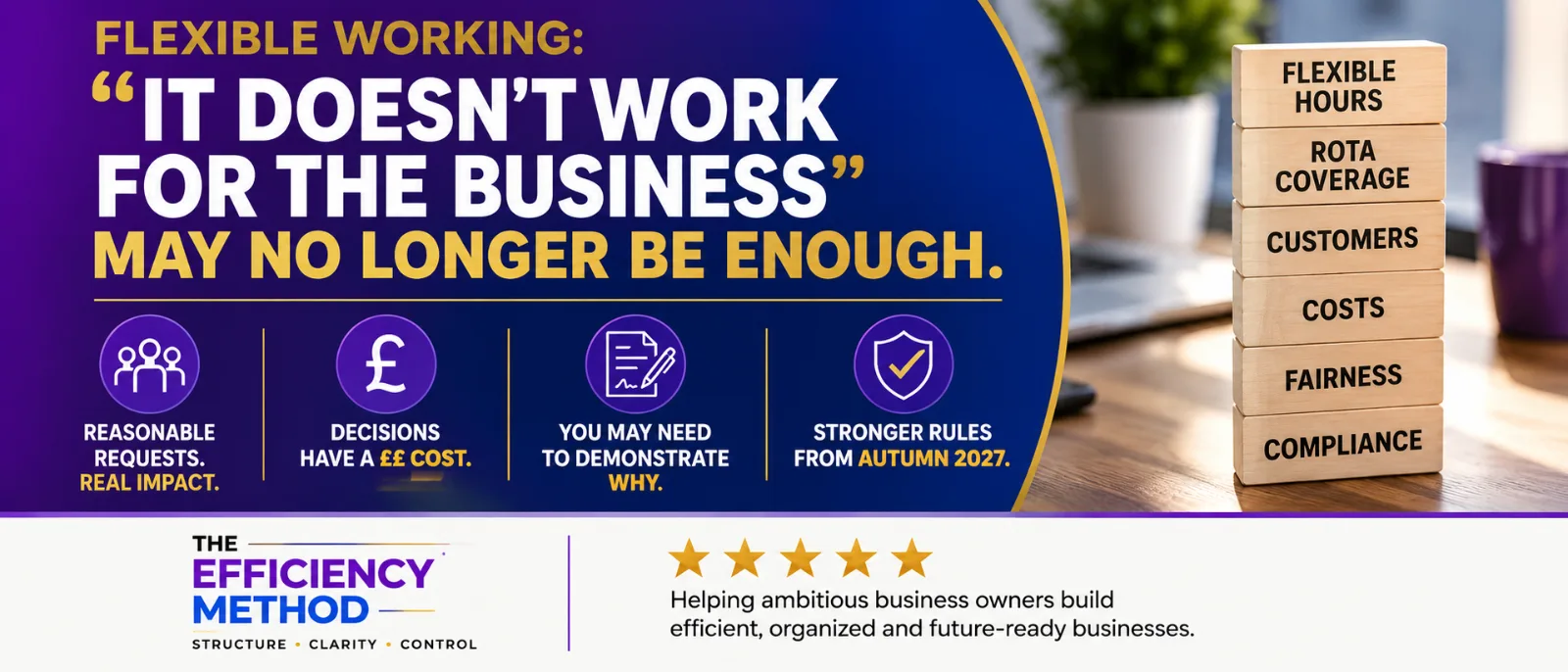
Flexible Working: “It Doesn’t Work” May Not Be Enough
Flexible-working decisions are becoming an operational issue as well as an HR one.
lexible-working requests can create real operational and financial consequences for SMEs. With changes expected from autumn 2027, businesses need to be able to demonstrate why decisions are reasonable rather than relying on assumptions.
Key takeaways
- Flexible-working decisions need evidence behind the commercial and operational reasoning.
- Inconsistent decisions can create resentment, grievances, management time and additional costs.
- Flexible-working requests can expose wider weaknesses in capacity planning, management authority and operational control.
An employee asks to finish at 3pm every day.
Another wants Fridays at home.
Someone else wants to compress five days into four.
Individually, each request might sound reasonable. But operationally, several reasonable requests can leave a small business with a very unreasonable problem.
Who answers the customer at 4.30pm? Who covers Friday? Who manages the team? Does someone else work overtime? Do you need additional staff?
And what happens when the next employee asks for the same arrangement?
Flexible working is already part of UK employment law, but the rules are set to become tougher for employers.
The Government has confirmed that from autumn 2027 employers considering rejecting a statutory flexible-working request will have to follow a prescribed consultation process. A rejection will need to be reasonable and based on one or more of the existing statutory business reasons.
For an owner-managed SME, that creates an important question:
Could you demonstrate why saying no was reasonable?
That is where an HR issue becomes an operational one.
Imagine an employee asks to finish two hours earlier, three days a week.
Your immediate reaction might be:
“No. We need somebody here.”
But what does that actually mean?
Would another employee need to provide six hours of additional cover every week?
At an illustrative employment cost of £20 an hour, that's:
£120 a week.
Around £520 a month.
More than £6,000 a year.
That is a genuine commercial consideration.
But if nobody calculates it and the employee simply receives:
“Unfortunately, we can't accommodate your request due to business needs,”
the business has lost the evidence behind its own decision.
The same applies to other reasons.
“We won't have enough cover.”
“Customers won't like it.”
“Productivity will fall.”
“We can't reorganise the team.”
Those may all be valid.
But increasingly the question becomes:
Based on what?
If additional cover costs £6,000, can you demonstrate it?
If customer service would suffer, do you know when customer demand actually occurs?
If productivity would fall, how is productivity currently measured?
The problem isn't necessarily making the wrong decision.
It is making a decision the business cannot properly support.
Then employee number two asks
This is where flexible working can become a much bigger operational headache.
You approve one employee working from home on Fridays.
Three months later, another person in the same team asks for Fridays at home.
Then a third does.
You cannot operate the department with everyone unavailable on Friday.
Now you have another problem:
“Why can Sarah do it but I can't?”
“You let him leave early.”
“Her job is the same as mine.”
Suddenly, the owner isn't simply managing flexible working.
They're managing resentment, perceived favouritism, employee relations, potential grievances and possibly the loss of good people.
And somewhere along the line somebody needs to explain why apparently similar requests resulted in different decisions.
If the answer is:
“Because that's what we decided at the time,”
the business has a problem.
The real cost isn't just legal
Mention employment-law changes and it's easy to jump immediately to Employment Tribunals.
For many SMEs, the everyday commercial costs are far more immediate.
Poor workforce decisions can create:
- Overtime and additional cover
- Agency and recruitment costs
- Management time
- Lost productivity
- Customer-service gaps
- Employee resentment and grievances
- Higher staff turnover
Consider an experienced employee earning £35,000 who leaves after a flexible-working request is handled badly.
The cost isn't simply advertising their job.
Someone has to recruit.
Managers spend hours interviewing.
Colleagues cover the vacancy.
The replacement needs training.
Productivity takes time to recover.
Customers may experience disruption.
The ££ cost can mount quickly.
The objective therefore shouldn't be:
“How can we reject flexible-working requests?”
It should be:
“How do we make commercially sound decisions without creating another expensive problem somewhere else?”
Construction, cleaning and property businesses aren't exempt from the problem
Flexible working doesn't simply mean working from home.
For construction businesses, requests might involve different start and finish times, compressed hours, reduced days or changes to administrative and management roles.
In commercial cleaning, changing someone's hours could affect client specifications, supervision, keyholding, lone-working arrangements or the cost of providing cover.
For property businesses, it could affect office coverage, tenant calls, inspections, contractor coordination or emergency response.
There may be perfectly legitimate operational reasons why a particular arrangement cannot work.
But can the business demonstrate them?
That distinction is becoming increasingly important.
Your managers could create the problem
You can have a perfectly good flexible-working policy.
But who actually receives the employee's request?
Usually a manager.
And what happens if their immediate response is:
“No chance.”
“We tried that before.”
“If I let you do it, everyone will want it.”
“Your job can't be done flexibly.”
That five-minute conversation could create hours of work later.
A policy sitting in a folder won't protect a business if the people making day-to-day decisions don't understand the boundaries of their authority or what needs to happen next.
This is a recurring problem in growing SMEs.
The CEO believes there is a process.
The manager believes they can make the decision.
The employee believes something different.
And nobody has a clear record of what actually happened.
Flexible working can expose a much bigger weakness
There is another side to this.
Sometimes a flexible-working request doesn't create inefficiency.
It reveals it.
Suppose a good employee wants to reduce from five days to four.
The immediate reaction might be:
“We need a full-time person.”
But when was that role last examined?
Is the employee spending hours producing reports nobody reads?
Are they attending unnecessary meetings?
Are tasks duplicated elsewhere?
Could low-value administration be removed?
Could the role actually be performed extremely effectively in four days?
A flexible-working request can force a business to look at something it should probably have examined anyway:
How does this job actually work?
That question becomes even more important as a business grows.
A CEO should understand who does what, when work needs to happen, what customers genuinely require and where the capacity constraints sit.
Without that information, flexible-working decisions become guesswork.
And guesswork gets expensive.
A growing business shouldn't run on “I think”
“I think Fridays are our busiest day.”
“I think we'd need another member of staff.”
“I think customers expect someone here.”
“I think productivity would fall.”
Experience and judgement matter.
But as a business grows, “I think” needs to become “I know.”
If the CEO still personally decides every change because only they understand how the business fits together, there is a problem.
If different managers make different decisions because there is no consistent approach, there is a problem.
If nobody knows the ££ cost of additional cover, there is a problem.
Flexible working hasn't caused those weaknesses.
It has exposed them.
Don't answer this with more bureaucracy
The answer isn't another six-page form, three approval stages and a spreadsheet nobody maintains.
Good operational control should make decisions easier, not slower.
The business needs enough structure to understand the commercial consequences, make a consistent decision and retain the evidence behind it.
Exactly what that looks like will depend on the size, structure, customers and workforce of the individual business.
But the CEO should be able to answer one question:
“If this decision was challenged six months from now, could we show why we made it?”
If the answer is no, there is work to do.
What could poor operational control already be costing you?
Flexible working may not be your biggest operational concern today.
But look at what sits behind it.
If you don't know where capacity exists, what is poor workforce planning costing?
If managers don't understand their authority, how much CEO time disappears into decisions that should never reach you?
If arrangements are agreed informally, how many inconsistencies are building across the team?
If nobody reviews whether an arrangement still works, how much inefficiency simply becomes “the way we've always done it”?
£500 a month?
£1,000?
£2,000?
Operational leakage rarely arrives as one enormous invoice labelled:
MONEY WASTED THIS MONTH.
It hides in overtime, additional cover, management hours, unnecessary recruitment, lost productivity, staff turnover and dozens of small decisions nobody goes back and examines.
“Can I change my hours?”
is all it takes to reveal a much bigger problem inside the business.
ACTION:
The Government is inviting views on these proposed changes, so if they could affect your business, take a few minutes to read the update and have your say. Check out the consultation GOV.UK
Frequently asked questions
About the Author

Julie-Ann Adams
Founder, The Efficiency Method
Julie-Ann has spent thirty years running operations, including building a waste and recycling business to £8 million, and is the first certified lead auditor in the world for EN 50625 and EN 50614. She now works with owner-managed businesses across the UK, finding where money, time and control are being lost, and fixing the cause rather than the symptom.
Share this Article
Ready to strengthen your business?
I help owner-managed businesses create practical systems that reduce costs, improve productivity and support compliance without unnecessary complexity.