

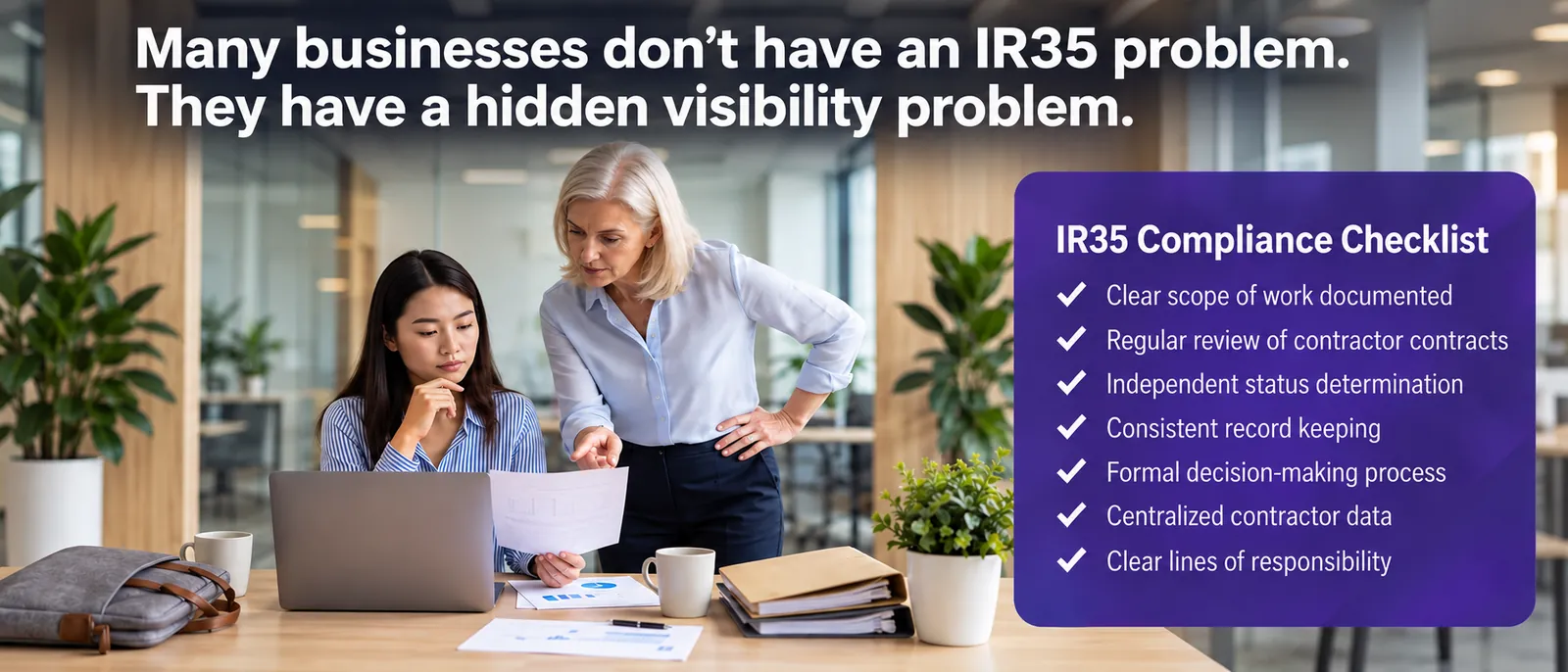
IR35: the compliance risk hiding in plain sight
Most businesses engage consultants, interims and contractors assuming the responsibility sits with the individual. That assumption is not always correct, and the bill lands on you.
Most businesses engage consultants, interims and contractors on the assumption that responsibility for IR35 sits with the individual. That assumption is not always correct. Unlike most compliance issues, this one arrives with no warning at all.
Key takeaways
- There is no alarm bell. An arrangement that was straightforward at the start can drift into risk without anything visibly changing.
- Contractor engagements evolve. A short-term requirement becomes a long-standing relationship nobody has reviewed.
- IR35 is discussed as a tax matter but it usually exposes a control problem: inconsistent records, unclear ownership, informal decisions.
- Growing businesses are the most exposed, because documentation has not kept pace with the growth.
- Where one compliance gap exists, others are usually waiting.
Most business owners are familiar with compliance obligations such as health and safety, data protection, insurance and financial reporting.
Yet one area regularly escapes attention until it becomes a problem: IR35.
Many organisations engage consultants, specialists, interim managers and contractors without ever considering whether the arrangement could create a compliance risk.
The assumption is often that responsibility sits with the individual contractor.
Unfortunately, that is not always the case.
The Risk That Often Goes Unnoticed
Unlike many compliance issues, IR35 rarely arrives with an obvious warning sign.
There is no alarm bell.
No notification.
No obvious indication that a contractor arrangement which appeared straightforward at the outset may now be exposing the business to risk.
For many organisations, contractor engagements evolve gradually over time. What starts as a short-term requirement can become a long-standing working relationship that receives little review or oversight.
This is where problems can emerge.
Not because businesses intentionally ignore their obligations, but because no one has stepped back and assessed the position.
A Wider Business Control Issue
IR35 is often discussed as a tax matter.
In reality, it frequently highlights something much bigger.
Businesses that experience difficulties in this area often have similar challenges elsewhere:
- Inconsistent record keeping.
- Limited visibility over key business activities.
- Unclear ownership of responsibilities.
- Informal decision-making.
- Documentation that has not kept pace with business growth.
These issues rarely remain isolated.
Where one compliance gap exists, others are often waiting to be discovered.
Why Growing Businesses Are Most Vulnerable
As businesses grow, flexibility can become a weakness.
Contractors are brought in quickly to solve problems, support growth or provide specialist expertise. New working arrangements develop organically and operational priorities take precedence over administration.
Over time, the original rationale, agreements and supporting records can become difficult to track.
The result is a business that believes everything is under control, but cannot easily demonstrate that control if challenged.
The Cost of Assumptions
One of the most common risks in business is assuming that someone else has already checked.
Someone in finance.
Someone in operations.
An external adviser.
The contractor themselves.
Unfortunately, assumptions rarely stand up to scrutiny.
Good governance depends on visibility, accountability and confidence that key risks are being actively managed.
Without those foundations, compliance becomes dependent on memory rather than process.
The Bottom Line
IR35 is not simply a contractor issue.
It is a business control issue.
And like many operational risks, it often remains hidden until someone starts asking questions.
For businesses that rely on consultants, contractors or specialist support, understanding where potential vulnerabilities exist is becoming increasingly important.
Because when you cannot clearly see a risk, it becomes much harder to manage it.
Need an outside pair of eyes to help? Get in touch for a free chat.
Frequently asked questions
About the Author

Julie-Ann Adams
Founder, The Efficiency Method
Julie-Ann has spent thirty years running operations, including building a waste and recycling business to £8 million, and is the first certified lead auditor in the world for EN 50625 and EN 50614. She now works with owner-managed businesses across the UK, finding where money, time and control are being lost, and fixing the cause rather than the symptom.
Share this Article
Ready to strengthen your business?
I help owner-managed businesses create practical systems that reduce costs, improve productivity and support compliance without unnecessary complexity.