

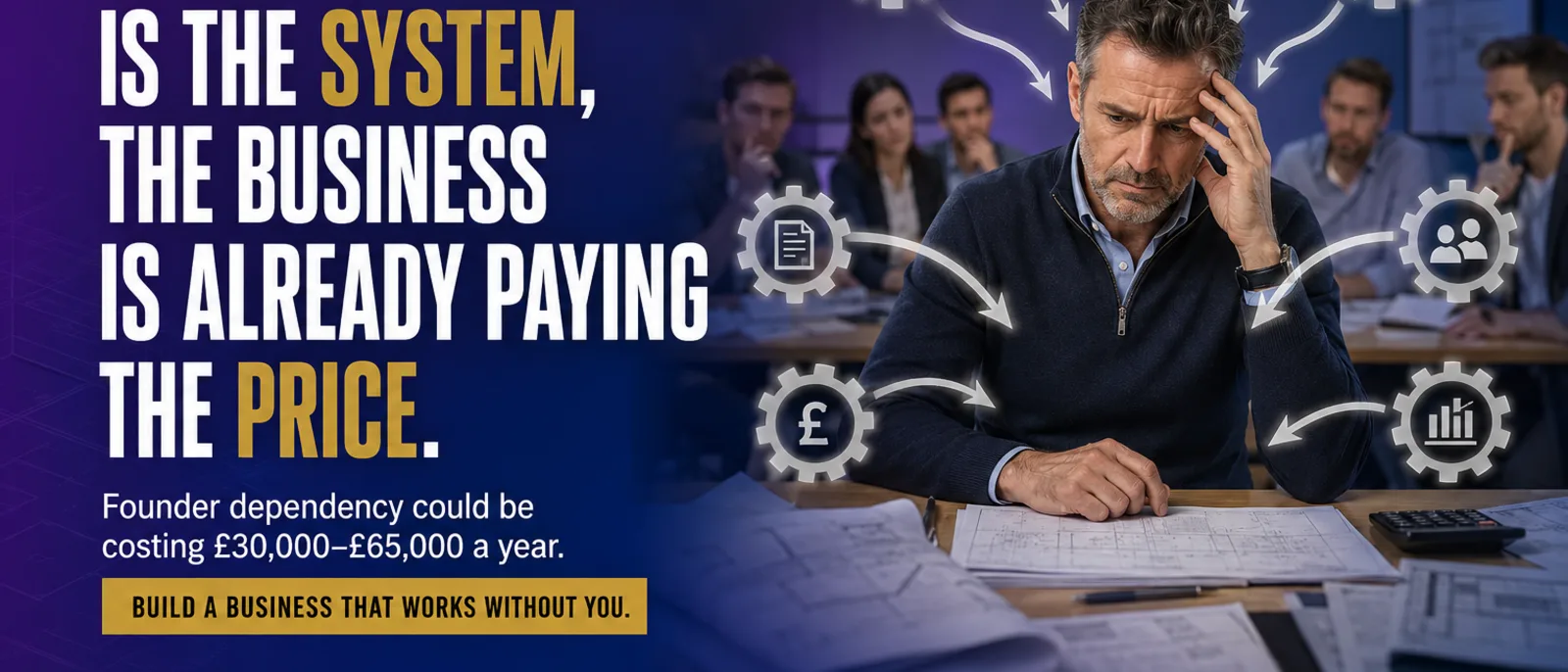
When the Founder Is the System, the Business Pays
Founder dependency can quietly cost a growing business tens of thousands of pounds every year.
A growing construction advisory business had capable employees but remained heavily dependent on its founder for information, decisions and routine operational guidance. Conservative estimates showed that the wider annual impact could reasonably have been £30,000 to £65,000, while clearer processes and responsibilities released approximately 5 to 10 hours of founder time every week.
Key takeaways
- Founder dependency can create significant hidden costs through interruptions, delayed decisions, rework and lost chargeable capacity.
- Delegation does not work properly when employees lack documented processes, clear responsibilities and defined decision-making authority.
- Moving operational knowledge out of the founder's head can release management capacity, strengthen the team and make the business more scalable.
A growing construction advisory business had skilled employees, established clients and the expertise needed to grow. But behind the professional exterior, too much of the business still depended on one person. The founder held much of the operational knowledge, answered routine questions and remained involved in decisions that should no longer have required him.
The real problem was not the team
The employees were experienced and technically skilled. The problem was the operational framework around them. Responsibilities were not always clearly defined, processes relied too heavily on memory and important knowledge remained in the founder's head.
- Employees interrupted the founder for routine guidance and decisions.
- Work could be delayed, duplicated or unnecessarily checked because responsibilities and authority were unclear.
What was founder dependency really costing?
On a salary of £75,000, the founder's time was worth approximately £38 an hour before employer costs. Losing 5 to 10 hours every week to operational questions, unnecessary checking and routine decisions represented approximately £10,000 to £20,000 of founder capacity each year. Five employees losing just one hour each per week created a further estimated £3,500 of lost salaried time. Once indicative employment costs were considered, the business could potentially have been spending £15,500 to £27,000 annually on time its operational weaknesses prevented people from using productively.
The bigger cost was not payroll
In a specialist advisory business, employee time can also be chargeable client time. Five lost employee hours each week at an illustrative £100 to £150 an hour represented £25,000 to £37,500 of annual chargeable capacity at risk. That figure should not simply be added to the salary calculation because some of the same time would be counted twice, but it demonstrates the commercial value of operational inefficiency.
- Project delays could create additional administration, unrecoverable time or client concessions.
- Errors, rework, slower client responses and missed opportunities could increase the financial exposure considerably.
£30,000 to £65,000 of potential annual impact
Using conservative assumptions, the broader annual impact could reasonably have been £30,000 to £65,000. This was not an audited loss. It was an illustration of the financial exposure created when expensive specialist time is consumed by poor delegation, undocumented procedures and excessive reliance on the founder.
Delegating more was not the answer
Simply telling the founder to delegate would not have solved the problem. Delegation without documented processes transfers uncertainty rather than ownership. If employees do not know the required outcome, the correct method or the limits of their authority, they will continue returning to the founder for reassurance.
- The processes generating the most questions and interruptions were identified and documented.
- Responsibilities and decision-making authority were clarified so employees understood when they could act independently and when genuine escalation was required.
Moving knowledge into the business
Clear standard operating procedures established what needed to be done, when it should happen, who was responsible, what information was required, what the expected outcome looked like and when an issue genuinely needed escalation. Instead of five people potentially developing five different ways of working, the company established a recognised standard.
The business recovered more than time
The changes released approximately 5 to 10 hours of management time every week. The founder gained more capacity to focus on clients, commercial decisions and growth, while employees could progress work with greater confidence rather than waiting for answers or approval.
- Specialist time was used more effectively, with fewer interruptions, repeated questions, unnecessary checks and rework.
- Clearer accountability, more consistent delivery and less reliance on the founder created stronger foundations for growth and resilience.
Stop using the founder as the operating system
A founder should drive the business forward, not be the process holding it together. If routine work slows down whenever the founder steps away, the operational dependency is already costing the business money.
Frequently asked questions
About the Author

Julie-Ann Adams
Founder, The Efficiency Method
Julie-Ann has spent thirty years running operations, including building a waste and recycling business to £8 million, and is the first certified lead auditor in the world for EN 50625 and EN 50614. She now works with owner-managed businesses across the UK, finding where money, time and control are being lost, and fixing the cause rather than the symptom.
Share this Article
Ready to strengthen your business?
I help owner-managed businesses create practical systems that reduce costs, improve productivity and support compliance without unnecessary complexity.